Published 11th February 2022. Updated 16th February 2024

Does it pay off to replace the old ventilation unit with a new one? Yes, as the investment can pay back in a couple of years. The new units are much more energy-efficient than the old models.
The question to consider is whether it is better to replace the old ventilation unit with a new one or to repair the old one. The larger the air volume that needs to be replaced within the building, the greater the energy saving potential of the new unit. With smaller air volumes, the payback time is longer.
The energy consumption of ventilation units that use modern technology is so much lower than that of the old models that it pays off to replace the ventilation unit. It may be possible to amortise the procurement price of the new unit within a few years. In addition, replacing the unit is not necessarily any more expensive than it would be to repair the old unit. For example, the energy consumption of Vallox 245 MV, the most energy-efficient ventilation unit in its class, can be well below half of the energy-consumption of units manufactured twenty or more years ago. Therefore, a ventilation unit upgrade is often one of the most cost-efficient and easiest ways to reduce the energy bill.
Larger ventilation units manufactured by Vallox (Ilmava 240, Vallox 250, Vallox 252, and Vallox 280) are widely used in schools and other public buildings. Some are also found in large detached houses. The units have proven to be relatively reliable, but several decades of use will inevitably cause repair needs. Future repair needs can be anticipated by replacing the unit before it fails and results in the need for emergency repairs.
If the technology of the unit needs to be replaced, the cost-efficiency of the repairs should be considered carefully. Even though Vallox provides nearly all of the spare parts also for older models, not all electronics and spare parts are still available as larger and easy to install entities. For example, pre- or post-heating resistors can be acquired as spare parts, but if the thermostats, overheating protectors, and electric boxes also need to be replaced, the repairs will require planning, time, and often also creativity.
Ventilation unit replacement gives numerous new and useful features
Ventilation unit replacement also gives access to numerous new and useful features. All MyVallox ventilation units have diverse connections to various remote control systems and the option to monitor and control the unit through the free MyVallox Cloud service. The partial heat recovery cell bypass enables easier management of the indoor temperature of the building in the spring and autumn. The standard delivery of new MV models include humidity and carbon dioxide sensors that only boost the ventilation based on the need. This creates additional savings, if the old unit has been constantly running at the standard speed or based on timer settings. Read more about the features of the MyVallox ventilation unit. Read more about MyVallox contol system
Does it pay off to replace the old ventilation unit? And what generates the savings?
The efficiency and defrosting automatics of heat recovery have developed over the years, as the amount of energy that is wasted by transmitting it outdoors in the waste air has reduced. Thanks to these features, the energy consumption of the ventilation unit’s post-heating radiator has reduced phenomenally. In fact, new Vallox units do not even have wasteful post-heating. Thanks to the EC technology, the fans alone save hundreds of euros a year per each unit through lower electricity consumption.
Enclosed is an indicative calculation of the energy consumption of ventilation units. Vallox 250 is used as the old comparison unit, but the calculation also applies to Vallox 240 and Vallox 252. The technology is the same in Vallox 280, except for EC fans. However, the consumption of the Radical fans used in Vallox 245 MV is only half of that of Vallox 280.
Indicative energy consumptions of ventilation units
Central Finland weather data
Supply air temperature +18 C
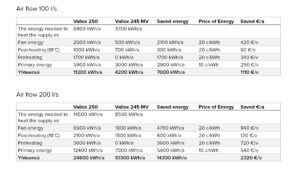
To make your own payback calculation, use the energy prices charged by your own energy company.
Use the *excel the downloadable excel-file as the template (availabe only in Finnish).
The primary energy need is taken from the heating system of the building, so the price can be, for example, that which is charged for district heating, oil, or electricity. The fan naturally always uses electricity as its energy source. The post-heating radiator of the old ventilation unit can be electric or a liquid radiator that is connected to the building’s heating network, in which case the energy price is that which is charged for heating energy. Pre-heating is always electric, unless a radiator connected to the geothermal heating circuit has been connected to the unit. In such a case, the pre-heating energy is, in theory, free, but rarely fulfils the entire energy need of pre-heating.
Increasing the supply air temperature increases the energy consumption of post-heating, but this increase is similar in scale in both new and old ventilation units. Increasing the temperature setting from 18 to 21 degrees quadruples the energy consumption of post-heating. Primary energy consumption is reduced by the same amount.
Based on the indicative calculation, replacing the ventilation unit reduces the energy need (when the air flow is 200 l/s) by 14,300 kWh/a, which equals an annual saving of 1,500 euros in total!
Here you can download a calculator for calculating the energy consumption of your ventilation unit.