Updated on 24.8.2026
Cooking smell removal makes cooking much more comfortable. The quick removal of smells and grease through the cooker hood makes the home more comfortable and easier to breathe in.
What is the difference between a cooker hood and an extractor hood?
A cooker hood does not contain a fan of its own. Instead, extraction is provided by a remote fan or roof fan located elsewhere in the building. In many cases, the fan is the extract air fan integrated into the ventilation unit of a mechanical supply and extract ventilation system. It is also common for the fan to be installed separately in the attic or on the roof as part of a dedicated extract ventilation system.
An extractor hood, on the other hand, is equipped with its own fan, which is located inside the hood housing or in its immediate vicinity.
The purchase of either a cooker hood or an extractor hood affects the dwelling’s ventilation system, and any modifications may require permits or approvals. For this reason, it is advisable to consult a ventilation designer or other qualified professional before making a purchase. A cooker hood or extractor hood is always connected to the building’s overall ventilation system and fire safety solutions. Therefore, the first step is to determine which type of ventilation system is installed in the property.
It is also important to note that ventilation systems with shared ductwork serving multiple apartments can generally accommodate only cooker hoods.

What should you consider when choosing a cooker hood?
1. Efficient fume extraction improves indoor comfort
The effectiveness of fume extraction is influenced by several factors, including the extract air flow rate, the distance between the cooker hood or extractor hood and the source of the fumes, and the volume of the hood’s fume collection area.
To ensure that smells, humidity and grease are not left hanging in the indoor air, observe the following:
- The smell collection part must be adequately large.
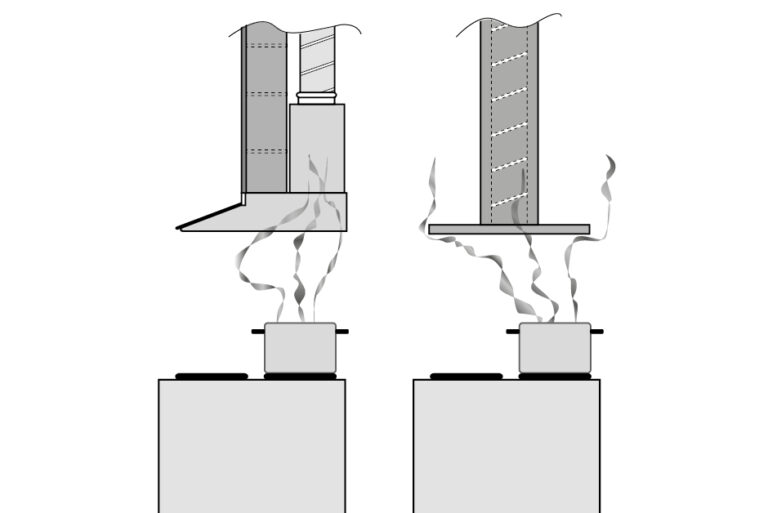
- The smell collection part of the cooker hood must be at least as wide as the cooker, collecting the vapour to be removed. From a cooker hood with a flat base the cooking smells can easily spread into the room air.
- Cooking smell removal works better next to a wall than in an island kitchen.
- The cooker hood should be placed at as low level as possible in the kitchen, but at least 50 cm away from an electric cooker and 65 cm away from a gas cooker.
- According to the building regulations, a cooker hood should remove at least 25 l/s of air when in use. However, efficient cooking smell removal requires a considerably higher extract air flow.
Measured according to the EN13141-3:2017 standard, the smell absorption capacity of the Vallox Delico cooker hoods is over 50% already at the minimum air flow (25 l/s). When the air volume is doubled, the smell absorption capacity rises to 75 per cent. The more air per second is removed, the higher the hood’s smell absorption capacity. At an airflow of 75 l/s, the smell absorption capacity of Vallox Delico cooker hoods is close to 85 per cent.
2. An Airtight Extract Air Valve Helps Keep Odours Away
If the cooker hood in the kitchen can be switched off, there must also be an extract valve in the kitchen to take care of the ventilation and the removal of smells from dirty dishes and cooking when the cooker hood is not on. This extract air valve is connected to the ventilation system of the home, not to the cooker hood.
The waste bin space in the kitchen cabinets can also be equipped with an extract air valve connected to the ventilation system. Through this valve, the smells from the waste bins are led directly out. This prevents the smells of food leftovers and other waste from spoiling the air in the kitchen.
3. The Choice of Extract System Affects the Ventilation of the Entire Home
Combining a Vallox roof fan with a Vallox cooker hood provides an effective and quiet fume extraction solution for detached houses. The speed of the roof fan is controlled directly from the cooker hood control panel.
The extraction duct serving the cooker hood or extractor hood should be constructed entirely of spiral-seam steel ducting. Since the duct carrying cooking fumes away from the hood will inevitably accumulate grease and dirt over time, ease of cleaning and fire resistance are essential considerations.
An extractor hood with its own motor, or a roof fan and cooker hood combination, can provide the high extract air flow rates required for efficient fume removal.
In smaller dwellings, such as apartments and terraced houses, kitchen fume extraction can also be integrated with the apartment-specific ventilation unit. This can be achieved, for example, with a Vallox 51K ventilation unit.
4. Control Method and Additional Features Affect Ease of Use
When choosing a cooker hood, it is important to pay attention to its technical features and compatibility with the building’s ventilation system. Consider how the cooker hood will be connected to the home’s ventilation system and how it is controlled. It is also worth considering the ease of installation and the desired visual appearance of the hood.
Some Vallox cooker hoods include additional features such as a temperature monitor, which detects if a hob has accidentally been left on. Features like these can be particularly valuable in busy family households. In addition, functions such as delayed shut-off help remove excess moisture even after cooking has ended, reducing the risk of condensation forming in the ductwork.
5. Ease of Maintenance and Cleaning Affects the Service Life of a Cooker Hood
When selecting a cooker hood, it is also important to consider ease of maintenance and cleaning, as these factors directly affect both performance and service life. Grease generated during cooking accumulates particularly in the grease filter and on the hood’s surfaces. If cleaning is difficult, it may not be carried out often enough, which can reduce extract airflow and compromise the performance of the entire ventilation system.
One of the key selection criteria is the design and cleanability of the grease filter. Vallox models use durable metal grease filters that can be easily removed and washed. Regular cleaning is essential, with a recommended cleaning interval of approximately once or twice a month. This helps maintain adequate ventilation performance and prevents grease from accumulating in the ductwork.
Smooth surfaces and a simple design make cleaning easier, while more complex structures may collect dirt and require additional maintenance. Cleaning is typically carried out using a mild detergent, so the hood’s surface materials should be able to withstand regular washing without damage.