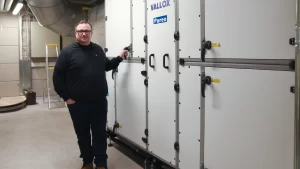
A prototype of Vallox Pureo SR unit handles ventilation in Vallox’s factory
To reduce the energy consumption of its factory and make managing ventilation easier, Vallox decided to renovate its ventilation system.
Vallox’s factory building is large and requires multiple ventilation units for effective results. The A2 factory hall and the adjacent offices were previously served by a single, shared air handling unit. In the ventilation renovation, the old unit was replaced with two modern units: Vallox Pureo TX 900 ventilates the offices and Vallox Pureo SR 3000 the A2 factory hall.
Prioritising energy savings
The decision to renovate the ventilation system was accelerated by Vallox’s efforts to save energy. The old air handling unit consumed 80,570 kWh of electricity and 120,750 kWh of thermal energy annually.
The energy consumption of the new Vallox Pureo units is on a next level. Their calculated electricity savings are over 51,000 kWh/a and thermal energy savings over 91,000 kWh/a.
The annual efficiency of the new units’ heat recovery is over 80%, while the old unit’s annual efficiency was below 50%.

Ventilation was also more difficult to control with the old unit.
“The factory hall and the offices have very different ventilation needs, so managing the ventilation of two spaces with one unit was extremely difficult,” says Mikko Mäki, Production Manager responsible for managing Vallox’s properties.
Thus, the indoor conditions were improved when the old unit was replaced with two units, one of which ventilates the factory wing of the building. The new solution provides on-demand ventilation in both spaces and is easy to control. It also improved the cooling of the offices.
Cost-effectiveness backed up by calculations
The old unit had been given a through service only a few years earlier. Replacing a completely functional unit raised doubts. Would the investment be worthwhile?
“To be honest, I was quite sceptical about the investment, since the old unit was perfectly functional and all the machinery had only recently been replaced,” Mäki confesses.
When considering a ventilation renovation, it is important to assess the investment’s profitability by conducting or have a qualified expert conduct a profitability calculation.
For Vallox, the profitability of the investment was calculated by Äyräväinen Tampere Oy, boasting a proud record in HPAC, electricity and automation design and consulting:
“An accurate profitability calculation is an important decision-making tool for the client. The person doing the calculation must have excellent know-how in energy consumption calculations, a good understanding of the entire system and the factors affecting it as well as a good idea of the costs of the project implementation. If this is the case, the resulting calculation will be reasonably accurate and useful in decision-making,” says Toni Salonen, Unit Manager (HPAC, Automation and Energy) at Äyräväinen Tampere Oy.
Salonen reminds that the report should include a reliability percentage for the calculation and a pay-off period calculation for the money invested.
After receiving the accurate profitability calculations, Vallox was sure of its decision: the envisaged investment would be profitable. The investment was assessed over a period of 25 years. Both the units and the demolition and installation costs as well as the calculated savings in electricity and thermal energy were taken into account in the profitability calculations. In the light of the estimated annual increase of energy prices, the pay-off period of the total investment was determined to be around four years.
From calculations to planning
It was only natural to order the site’s ventilation plan from Äyräväinen Tampere Oy, with whom Vallox has a long history.
“Designing the ventilation system was relatively easy for us since we were already familiar with the building – having designed the original ventilation system. Modifying the system was effortless. We have over 25 years of experience of working on this building and we knew its technical aspects. Thanks to this experience and knowledge, we were in a good position to plan the renovation,” says Salonen from Äyräväinen.
Vallox has been very happy with the ventilation renovation.
“In addition to the relatively short pay-off period for an investment in energy efficient, we gained improved ventilation performance,” says Mäki.
Investment and product development go hand in hand
When the idea to renovate the ventilation system of the A2 hall and the adjacent offices was initially brought up, Vallox was about to introduce new Vallox Pureo models into the market. Vallox saw this as an opportunity to test the new products before they hit the market.
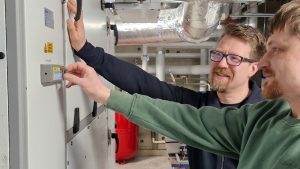
The Vallox Pureo SR 3000 air handling unit was at the prototype stage at the time, and the product development team was given front-row seats to follow the installation and setup of the new model.
“Our product development team received valuable feedback about unit installation directly from the renovation site,” says Mäki.
During the installation of the unit, a few concerns about the unit’s installation and movability were raised, and these could be fixed before the start of sales and production.
Savings and improved energy efficiency through renovation
The ventilation renovation project was finished in autumn 2025 and the investment has already reduced the factory hall’s energy bills.
For Vallox, environment is part of the company’s operating policy, and it is constantly striving to reduce the environmental effects of its operations. For example, Vallox has already switched to motion-detecting and time-scheduled LED lights at this factory. The efficient heat recovery function of modern ventilation units makes improving the energy efficiency of its properties even easier. Thus, this financial investment was also an investment in the environment.