Optimal indoor air with an enthalpy heat recovery cell
Heat and moisture recovery with an enthalpy heat recovery cell
Freshness is not the only quality of optimal indoor air – temperature and moisture also contribute to a pleasant and healthy indoor climate.
Popular in Central Europe and the USA, enthalpy technology is now also available for Vallox ventilation units in Finland.
Equipped with an enthalpy heat exchanger, MyVallox CFi ventilation units guarantee a pleasant indoor climate through efficient heat and moisture recovery.
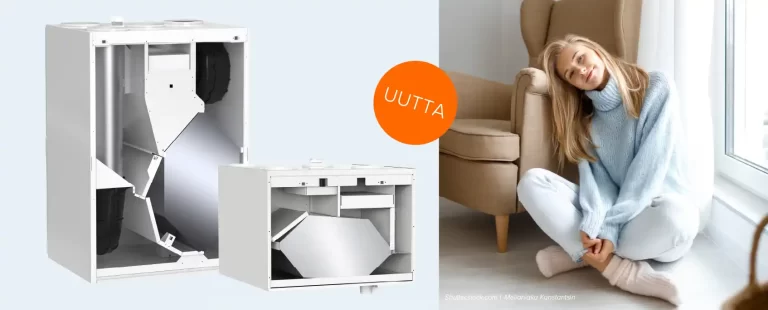
Excellent heat recovery capacity
An enthalpy heat recovery cell is a cross-counter flow cell that transfers heat from extract air into fresh and filtered outdoor air before it enters the room. Since the cell keeps extract air and supply air separate, no odours or other impurities are transferred from extract air into supply air.
The thermal efficiency of Vallox’s enthalpy heat recovery cells is the best on the market, while their pressure drop is the smallest. In dry conditions, the thermal efficiency of enthalpy heat recovery cells is nearly equal to aluminium heat recovery cells.
In fact, MyVallox CFi ventilation units with an enthalpy heat recovery cell have the same heat recovery annual efficiency as units with an aluminium heat recovery cell, which is up to 84% (MyVallox 119 CFi).
* Southern Finland, Helsinki-Vantaa, TRY 2020
Enthalpy heat exchanger maintains optimal air humidity
The relative humidity of indoor air is an important part of the indoor climate. The optimal relative humidity level is 30–60%, however, the level can change by season. Indoor air often becomes too dry in winter.
Ventilation units equipped with an enthalpy heat exchanger provide a solution to this problem. The enthalpy heat recovery cell does not recover only heat from extract air but also up to 70% of its moisture and transfers it into supply air. In units with an aluminium heat recovery cell, this moisture is condensed and drained out.
The recovery of moisture in air reduces the dryness of indoor air in winter and excessive humidity in summer.
Key properties of enthalpy heat recovery cells

Moisture recovery
An enthalpy heat recovery cell has a polymer film between the supply and extract air flows. The film allows moisture to pass from humid air into dry air. When outdoor air is dry in winter, moisture is recovered from extract air and transferred into supply air, while in summer, moisture is removed from humid supply air into extract air if the air passes through the heat recovery cell.

Less frequent defrosting
Since most of the moisture is transferred into supply air, a ventilation unit with an enthalpy heat recovery cell needs to be defrosted less frequently than a traditional ventilation unit equipped with an aluminium heat recovery cell.

Less condensing water
As moisture is transferred into drier air through the film in the cell, the ventilation unit causes less condensation. However, it is recommended to install a draining system for condensing water in colder climates.

Certified quality and safety
The enthalpy heat recovery cells used by Vallox have been Eurovent-certified and they meet the VDI 6022 standard hygiene requirements.
They also meet the EN 13501 standard (Classification of reaction to fire) fire safety requirements.
Differences with aluminium heat recovery cells
The water molecules in extract air are condensed when they come into contact with the surface of the enthalpy heat recovery cell’s layers and pass through the polymer film into drier air, using ion exchange. In winter, dry outdoor air binds the water molecules on the supply side of the cell. The recovered heat and moisture are released into supply air, providing the apartment with pleasant, warm and fresh air, while also reducing the dryness of indoor air caused by mechanical ventilation. In summer, excess moisture is transferred from outdoor air into extract air if the air passes through the cell.
Because the enthalpy heat recovery cell transfers moisture from extract air back into supply air, it does not cause as much condensation as an aluminium heat recovery cell. This also lowers the cell’s freezing point. Thus, a ventilation unit equipped with an enthalpy heat recovery cell requires less frequent defrosting than a ventilation unit that has an aluminium heat recovery cell.
Differences with rotary heat exchangers
The polymer film in the enthalpy heat exchanger transfers moisture efficiently in a hygienic manner. The extract air and supply air flows are kept separate to prevent odours and organic particles from passing between the two air flows.
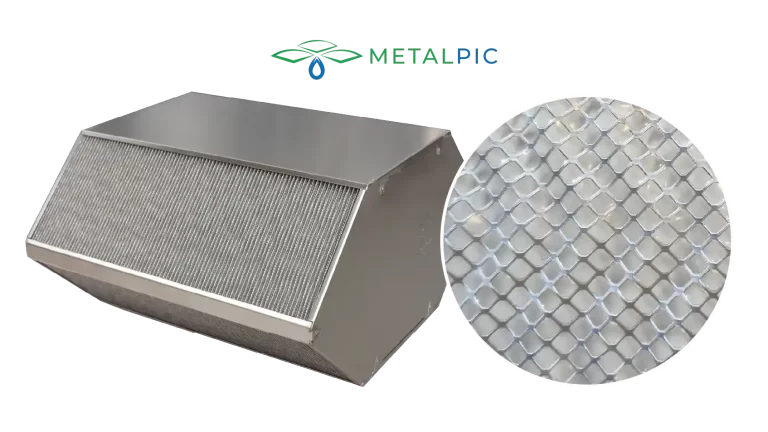
Unique patented Metalpic material
Vallox uses enthalpy heat recovery cells with a patented layer structure that use ion exchange.
The cell material has two layers, which have separate functions. Aluminium mesh supports the thin polymer film that allows moisture to pass through.
Water vapour molecules pass through the polymer structure naturally, whereas other molecules and gases, such as O2, CO or NH3, cannot permeate it.
The material is airtight, hygienic and mouldable. The layers have grooves that enlarge the surface recovering heat and moisture. The film does not become blocked, and the moisture recovery capacity does not weaken over time.
Where can I get an enthalpy heat recovery cell?
Which ventilation unit models are compatible with enthalpy heat recovery cells?
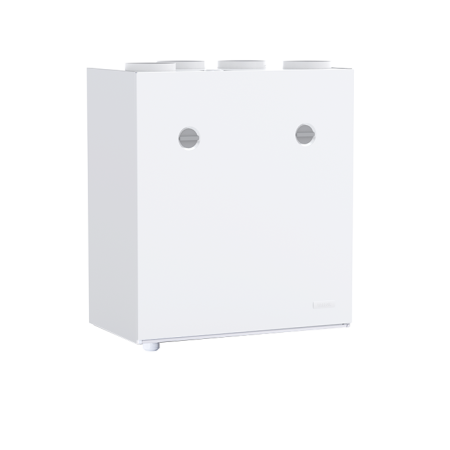
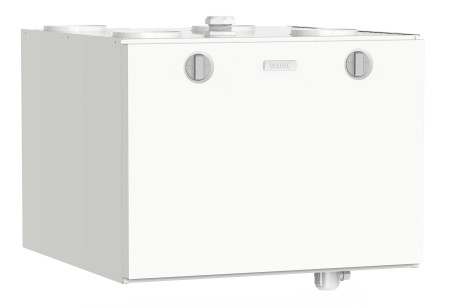
Enthalpy heat recovery cells will be available for the following ventilation units from autumn 2026 onwards: MyVallox 51 CFi, MyVallox 99 CFi, MyVallox 119 CFi, MyVallox 149 CFi, MyVallox 245 CFi and MyVallox 245 CFi VKL.
How do I know if a unit has an enthalpy heat recovery cell?
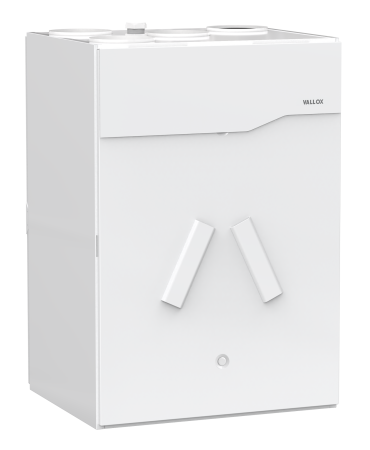
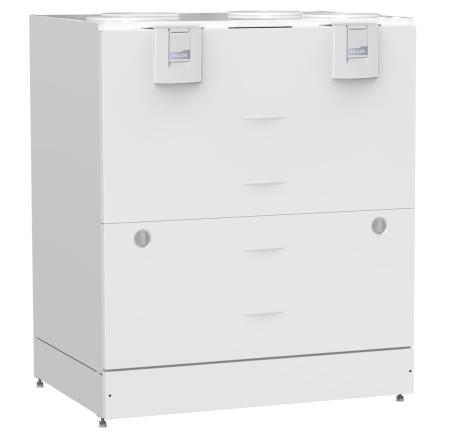
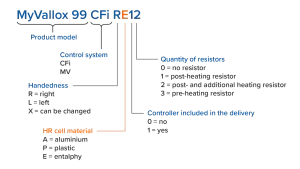
You can recognise a ventilation unit model that has an enthalpy heat recovery cell from the identifier of the model. Model identifiers have either E (enthalpy) or A (aluminium) to indicate the heat recovery cell type, e.g. MyVallox 99 CFi RE12.
Can I replace the aluminium heat recovery cell of my current unit with an enthalpy heat recovery cell?
An aluminium heat recovery cell can be replaced with an enthalpy heat recovery cell as they are of the same size. The cell type can also be changed in the MyVallox Cloud and MyVallox Home settings; however, this does not change the unit’s freeze protection parameters or fan settings. Thus, replacing only the heat recovery cell should be considered carefully.
If you decide to replace only the heat recovery cell, the moisture recovery benefits of the enthalpy heat recovery cell will be available to you. However, please note that not all the unit settings will be optimised.
Still have questions? Explore our Frequently Asked Questions:
What is an enthalpy heat recovery cell? How does it differ from an aluminium heat recovery cell?
Copy link
In terms of operation, the enthalpy heat recovery cell is nearly identical to the aluminium heat recovery cell. The cells are the same size and look similar. The difference is that the cell layers of the enthalpy heat recovery cell are made from film, not aluminium, which is permeable to both heat and moisture.
An enthalpy heat recovery cell prevents excessive dryness of indoor air in winter, it does not freeze as easily as an aluminium heat recovery cell, and it causes less condensation than an aluminium heat recovery cell.
How does the enthalpy heat recovery cell work?
Copy link
The enthalpy heat recovery cell has a polymer film that it is permeable to moisture. The working principle of the cell is based on water vapour diffusion: Water vapour passes through the film. Moisture is carried from humid air to dry air without mixing the two air flows. Thus, in winter, both heat and moisture is transferred from indoor extract air to cold and dry outdoor air, and vice versa in summer. In summer, the enthalpy heat recovery cell reduces the humidity of supply air when outdoor air is more humid than indoor air, and the air passes through the heat recovery cell. In that case, some of the moisture in outdoor air is transferred to extract air before it reaches the supply air.
Can I replace the aluminium heat recovery cell of my current unit with an enthalpy heat recovery cell?
Copy link
Yes and no. An enthalpy heat recovery cell is identical in size and shape to an aluminium heat recovery cell, so they are physically interchangeable. However, the unit’s operation is not optimal with an enthalpy heat recovery cell in very cold conditions, as the unit parameters have been designed for an aluminium heat recovery cell. The unit’s factory parameters cannot be changed by the user. After changing the cell, the benefits of the enthalpy heat recovery cell are available to the user even if the unit is not operating at the optimal level.
Later, when carrying out maintenance and ordering spare parts, it is important to note that the type code in the type plate is incorrect, because the heat recovery cell has been replaced.
Can a unit equipped with an enthalpy heat recovery cell be installed without a draining system for condensing water?
Copy link
We do not recommend this. Enthalpy heat recovery cells have long been used in Central Europe, i.e. in climates that are much warmer than the Finnish climate. Therefore, an enthalpy heat recovery cell will cause some condensing in winter, albeit less than an aluminium heat recovery cell would. Thus, we always recommend providing the unit with drains.
Does the enthalpy heat recovery cell let odours or impurities in indoor air?
Copy link
The enthalpy heat recovery cell is highly selective on water vapour. It facilitates the transfer of moisture from one air flow to another, but blocks odours and other impurities quite effectively.
Does the enthalpy heat recovery cell form moisture in dry indoor air?
Copy link
No. An enthalpy heat recovery cell facilitates the transfer of already existing moisture from humid extract air to dry supply air. Indoor air humidity is attributable to doing laundry, cooking and breathing, for example. An empty apartment does not become humid on its own.
How much moisture does the cell recover?
Copy link
The cell typically transfers approximately 50–70% of extract air moisture to supply air and vice versa.
Can I wash the enthalpy heat recovery cell?
Copy link
Yes, you can. The cell can be washed with water and mild detergent. Be extremely careful when handling the cell to avoid damage to the cell layers.
Is there paper in the enthalpy heat recovery cell?
Copy link
No. The cell is made from aluminium and a material called Metalpic, which combines aluminium and polymer.
What will happen if I change the cell type in the unit settings?
Copy link
The cell type can only be changed in the unit’s expert settings, however, this does not affect the unit’s factory settings, which determine, for example, the defrost parameters for the unit’s original cell.