Updated on 30.8.2026
In apartment blocks, terraced houses and holiday homes, the removal of cooking smells is often arranged via a ventilation unit.
Cooking Extract Can Also Be Routed Through the Ventilation Unit in Apartment Buildings, Terraced Houses, and Holiday Homes
For cooking extract, a system separate from the building ventilation is generally recommended, such as a cooker hood with its own fan or a cooker hood connected to a roof fan. This is because a dedicated cooking extract system typically provides a significantly higher extract airflow rate than a ventilation unit. However, cooking extract can also be handled through the ventilation unit in apartments, terraced houses, and smaller holiday homes. This is a cost-effective and energy-efficient solution, as smaller dwellings do not require equally high extract airflow rates. There are no technical or building code restrictions preventing cooking extract from being routed through the ventilation unit.
How Is a Cooker Hood Connected to a Ventilation Unit?
A ventilation unit can be connected to a cooker hood so that both operate together as part of the building’s ventilation system. The most common solution is to connect the cooker hood to an extract air duct leading to the ventilation unit or roof fan. In this configuration, the cooker hood does not have its own fan but instead functions as a controller and an integral part of the overall ventilation system.
When the cooker hood is used during cooking, it can control the ventilation unit by boosting ventilation. This is typically achieved through a damper or control signal, causing the ventilation unit to automatically increase fan speed. As a result, cooking fumes, odours, and moisture are effectively removed from the kitchen while maintaining good indoor air quality throughout the dwelling.
In many solutions, the cooker hood is equipped with an adjustable or motorized damper. Opening the damper increases the extract airflow rate. This makes the system practical and user-friendly, as the boost function is activated automatically without the need for separate adjustments. Overall, combining a cooker hood with a ventilation unit improves both energy efficiency and indoor air quality. The integrated operation provides effective cooking extract while ensuring balanced ventilation throughout the home.
How Should the Heat Recovery Function Be Used in a Ventilation Unit Connected to a Cooker Hood?
A frequent question is whether cooking smells should bypass the heat recovery cell inside the ventilation unit. If a Vallox ventilation unit is used, there is no need for a bypass. This is because the plate heat exchanger never brings the smells and humidity from the extract air back into the supply air.
Vallox has also studied the issue with regard to the reliability of the ventilation system and has found that if a heat recovery bypass is used for cooking smell removal, it may cause problems to the ventilation unit in winter. This is because bypassing the heat recovery reduces the volume of warm extract air passing through the cell, while the flow of cold outdoor air remains unchanged. In such circumstances, the freeze protection of the unit responds too early to the outdoor air temperature; at worst, the cell may freeze completely.
If, for instance, 8 l/s of air is extracted through the cooker hood, more than 1,500 kWh of energy per year is lost from heat recovery in one apartment. The loss equals almost a third of the heat energy recovered from extract air in a small apartment. This can – and must – be avoided with an independent extraction for the kitchen and with a tight cooker hood damper. Even a minor leak in the cooker hood damper or incorrect use can, however, increase your electric bill by tens of euros.
With respect to the maintenance of the ventilation unit, a bypass has no practical significance. Relatively heavy grease particles that have passed the grease filter of the cooker hood usually do not travel very far in the duct but stick to the duct wall along the first metres of the duct. The smallest particles may travel to the extract air filter of the unit, which needs regular maintenance in any event.
The impact of the heat recovery cell on the extract air flow of the cooker hood is quite small. For instance, at an airflow of 80 l/s, the pressure loss of the heat recovery cell of Vallox 096 is 92 pa. With a bypass, the air flow could theoretically increase by about 15 l/s if there was no pressure loss in the bypass duct. At an air flow of 30 l/s, the pressure loss of the cell is only 23 pa. The dimensioning of the duct system and careful installation have a greater impact on the air flow of the cooker hood.
Cooker Hood Capture Efficiency Is More Important Than High Extract Airflow Rates
The factors affecting the cooker hood’s efficiency in removing cooking smells include the size and design of the vapour collection part, the distance from the cooker top and the extraction air flow of the cooker hood or fan. With respect to cooking smell removal, the air flow is a less important factor than the hood’s capacity to capture cooking smells.
Already at an air flow of 50 l/s, the Vallox X-Line cooker hoods have the capacity to capture 72% of cooking smells. If the air flow of the cooker hood rises to 60 l/s, the cooking smell capturing capacity increases by 8 percentage points. The cooking smell capturing capacity of the Vallox Delico cooker hoods is approximately 74% at an air flow of 50 l/s, and it increases to nearly 85 per cent at an airflow of 75 l/s.


Tips for more efficient cooking smell removal
For better cooking smell removal, choose a cooker hood with a good capacity to capture cooking smells. Install the cooker hood at an adequately low height and use spacious dimensioning for the cooker hood duct. The grease filter must be washed regularly. Automatic boosting of the ventilation when the cooker damper opens is also helpful. Automatic boosting can be arranged with the help of the timer of the Vallox PTXPA MC cooker hood damperand the Vallox KTXA cooker hood or, in Vallox MV models, with the KTXA cooker hood.
How Is a Cooker Hood Controlled Through a Ventilation Unit?
Control Hoods Are Suitable for a Variety of Applications
Controlling a ventilation unit through a cooker hood is based on the principle that the cooker hood functions as part of the building’s ventilation system rather than as a separate appliance. In Vallox solutions, this is primarily achieved using control hoods, which do not contain their own fan but instead control the ventilation unit or roof fan.
The key operating principle is that the cooker hood detects when it is being used, typically through the opening of a damper or the use of a switch, and transmits this information to the ventilation unit. This can be achieved, for example, using a damper position signal. The signal informs the ventilation unit that the cooker hood is in operation, prompting the unit to automatically boost fan speed. As a result, cooking fumes, odours, and moisture are effectively removed from the kitchen without the user having to adjust the ventilation system separately.
Among Vallox control hoods, the X-Line PTX, PTXP and PTXPA models, as well as the Delico PTD EC and PTD AC models, are specifically designed for this purpose. They are intended to control either a ventilation unit or a roof fan and offer features such as a timer-controlled damper, optional overrun operation, and control options for both AC and EC fans. With these models, ventilation boost becomes a natural part of cooking. When the hood is activated, ventilation is increased, and after use the system can automatically return to its normal operating level through a timer function.
Control can also be based on a manual or motorized damper. When the user opens the cooker hood damper, the extract airflow increases and the system simultaneously receives a signal indicating that boost ventilation is required. Motorized dampers can operate automatically and include a timer function, allowing them to close after a preset delay. This overrun period is important because it ensures that moisture generated during cooking is removed from the ductwork rather than being left to condense inside the system.
Cooker Hoods for Central Exhaust Duct Systems and Apartment-Specific Solutions
In apartment buildings, control solutions differ somewhat. The Vallox KTX, KTD, KTXA and KTD A models are designed for central exhaust duct systems and apartment-specific ventilation solutions. In these applications, the ventilation system is often pre-balanced, and the cooker hood functions as part of the overall system by regulating and controlling extract airflow rates. The KTXA and KTD A models are suitable for both central exhaust duct systems and apartment-specific ventilation units. In these solutions, the operating principle remains the same: the cooker hood regulates airflow and can signal the system when boost ventilation is required.
In addition, Vallox systems can utilize the ventilation unit’s own control logic, such as the MyVallox control system. In this case, the signal sent by the cooker hood is integrated into the unit’s control system, which automatically maintains ventilation balance. This is particularly important because high extract airflow rates can create excessive negative pressure within the apartment. Vallox systems can compensate for this by increasing the supply airflow, improving comfort and preventing issues such as doors becoming difficult to open.
The result is a balanced, energy-efficient, and user-friendly ventilation solution in which cooking extract and whole-apartment ventilation operate seamlessly together.
Ventilation Unit and Cooker Hood Integrated into a Single System
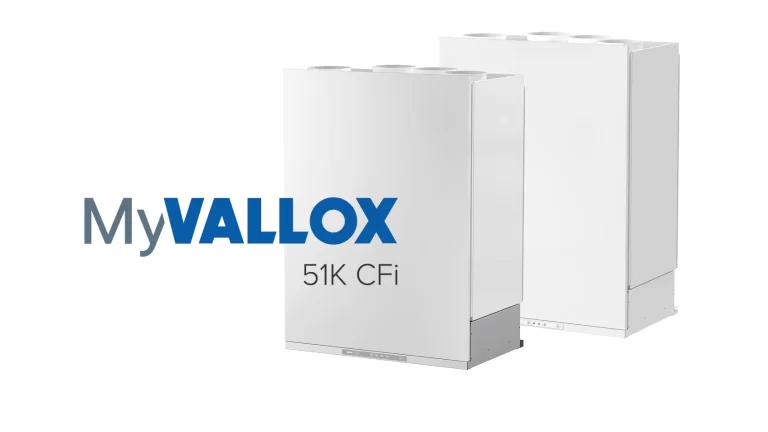
MyVallox 51K CFi efficiently combines ventilation and kitchen extract ventilation in a single space-saving solution. Designed for installation within kitchen cabinetry, the unit is particularly well suited to small apartments where a clean and streamlined appearance is desired. After installation, only the minimalist front panel of the Vallox Captura cooker hood remains visible, featuring elegant capacitive touch controls.
Thanks to its metal construction, the MyVallox 51K CFi is safe and suitable for installation in kitchen environments.