The effect of a clogged fine filter on the annual efficiency of a ventilation unit
Published 16.06.2026 / Writer: Marko Kannisto
Modified 27.10.2026

Writer: Marko Kannisto, Product Manager
Summary
Note to the reader: The figures used in this article are illustrative examples. In real-world applications, results vary depending on the building, its usage profile, the climate zone and the ventilation system. Assessing the annual efficiency of a ventilation unit often requires the use of default values, as conditions are not constant throughout the year. Nevertheless, these examples clearly illustrate the scale of the phenomenon and its mechanisms of action at a practical level.
An imbalance in air flows is one of the most common reasons for a decline in the actual annual efficiency of a ventilation unit – and a clogged fine filter is a good, concrete example of this. This article uses an example to illustrate how a dirty fine filter can, in practice, reduce heat recovery and increase heating energy consumption, and how MyVallox CFi units maintain balanced airflows throughout the entire operating cycle.
1. Framing the problem
When discussing the energy efficiency of a ventilation unit, attention is often focused on the efficiency of the heat recovery unit. In actual use, however, what matters most is the annual efficiency of the entire system – and, in particular, whether the supply and extract air flows remain in balance throughout the year.
Balanced airflows are not just a technical detail. They have a direct impact on how much thermal energy is actually recovered in a building – and how much energy escapes unnoticed.
Initial situation: airflows in balance
Let us first consider a situation in which the ventilation unit is operating as intended. Assumptions:
- Supply air flow: 65 l/s
- Exhaust air flow: 65 l/s
- Efficiency of the heat recovery cell: 89 per cent (MyVallox 149 CFi unit)
- Annual efficiency of the ventilation unit: 83 per cent (MyVallox 149 CFi unit)
When the airflows are balanced, heat recovery operates at its best. The thermal energy recovered from the extract air is efficiently transferred to the supply air, and the high efficiency of the heat exchanger is also reflected in a good average annual efficiency figure throughout the year.
A clogged fine filter – an unnoticed factor reducing energy efficiency
In actual use, the fine filter for the supply air will inevitably become dirty over time. This increases the pressure drop on the supply air side and leads to a reduction in the supply air flow, whilst the extract air flow often remains virtually unchanged. As a result, the airflows in the ventilation unit are no longer balanced.
The pressure drop caused by a new fine filter is typically around 20 Pa. When the filter becomes dirty, it is reasonable to estimate that the pressure drop caused by the filter will increase by around 25–30 per cent. In ventilation technology, the pressure drop is proportional to the square of the air flow rate; therefore, the air flow rate does not decrease in the same proportion as the pressure drop increases, but rather in proportion to the square root of the pressure drop.
A reduction in airflow as the filter becomes dirty
When a fine filter becomes clogged, causing its pressure drop to increase by around 25–30 per cent, the air flow is calculated to decrease by around 10–12 per cent. In this example, the supply air flow rate therefore decreases from 65 l/s to 58 l/s. In other words: when the fine filter becomes clogged, the airflows are no longer balanced.
An example of a situation where the fine filter has become dirty as described above:
- Supply air flow: 58 l/s
- Exhaust air flow: 65 l/s
Even if the efficiency of the heat recovery cell itself were still 89 per cent, the system as a whole would no longer be able to make full use of it.
2. Method / principle
In heat recovery, the heat transfer can be described, in simple terms, by the following formula:

where:

The amount of heat energy transferred is always limited by the lower of the two air flow rates. When the supply air flow decreases, some of the thermal energy in the extract air is lost from the building without being utilised. In other words, even if the heat exchanger’s efficiency were still 89 per cent, it would not be possible to recover the same amount of energy from the exhaust air as before.
Estimation based on air flows
In a balanced situation:

In the event of an imbalance (the fine filter is dirty):

The proportion of the thermal energy in the exhaust air flow that can be utilised is therefore:

In other words, only around 89 per cent of the thermal energy in the extract air flow can be transferred to the supply air.
Effect on the machine’s annual efficiency ratio
A simplified expression for the change in annual efficiency can be written as:

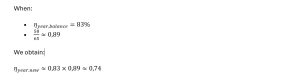
In practice, the machine’s actual annual efficiency therefore falls from 83 per cent to 74 per cent when the supply air flow decreases as a result of the fine filter becoming clogged.
Please note the following regarding the energy consumption of the fans: In practice, compensating for the clogging of the supply air fine filter requires increasing the speed of the supply fan, which increases the fan’s electricity consumption to some extent. However, modern EC fans are extremely energy-efficient, and their additional energy consumption is typically very low compared with the loss of heating energy caused by imbalances in air flow. For this reason, the increased energy consumption of the fans has not been specifically taken into account in these calculations, and it has no significant impact on the overall result.
3. Application example
Using the example air flow rates, the heating energy requirement for ventilation can be calculated as 9,301 kWh per year. This has been calculated in accordance with the guidelines issued by the Ministry of the Environment, for climate zone I (Helsinki-Vantaa), test year TRY 2020.
Next, let’s work out how much energy can be recovered from this using heat recovery.
Balanced airflows (annual efficiency 83 per cent):
9 301 kWh × 0,83 = 7 720 kWh
Unbalanced airflows (annual efficiency 74 per cent):
9 301 kWh × 0,74 = 6 883 kWh
The difference is 837 kWh per year.
As the filters do not remain dirty for the whole year, let us consider an average scenario in which the effect lasts, for example, for half the year:

Assuming the price of electricity is 0.20 €/kWh, the cost is:
420 kWh × 0,20 € = 84 € / year
This may not be a particularly significant additional cost over the course of a single year, but it is nonetheless a hidden cost that is worth bearing in mind. When considering the entire life cycle of the equipment, this already adds up to a significant cost. It is also worth noting that, in this case, the user has done nothing wrong. However, given the current high cost of electricity, it is worth being aware of this hidden cost as well.
4. Design recommendation
Well, is there anything we could do to sort this out? Does the resident have to adjust the airflows at set intervals, and do so based on a ‘gut feeling’?
That is, of course, one possibility, but there is also a slightly more elegant alternative. Indeed, Vallox’s new MyVallox CFi ventilation units are designed to operate energy-efficiently even under real-world operating conditions.
MyVallox CFi units:
- The following changes in air flow are ongoing.
- They automatically compensate for any build-up of dirt on the supply air fine filter.
- They maintain a balance between the supply and extract air flows throughout the entire operating cycle.
In this case, the high annual efficiency is maintained in practice as well – not just under laboratory conditions.
In conclusion: energy efficiency is no accident
Balanced airflows are a key prerequisite for good annual efficiency. Without intelligent control, a clogged fine filter can reduce energy efficiency by a surprisingly large amount and increase energy costs.
MyVallox CFi units offer a solution to this problem. They help to save energy, reduce heating costs and ensure that the ventilation system operates efficiently all year round.
The result is better indoor air quality, less wasted energy and greater savings for the user.
5. References and related documents
Technical specifications for the MyVallox 149 CFi unit (Vallox product documentation).