Updated 21.8.2026
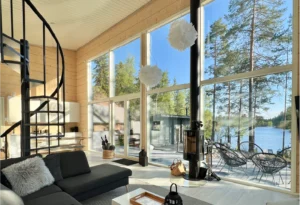
Healthy indoor air is crucial in terms of well-being.
People spend up to 90% of their time indoors and breathe thousands of litres of air each day. Ventilation aims at creating healthy and cosy indoor air in the building. Healthy indoor air is crucial in terms of well-being, even though it is not as concrete as food, water or motion.
It is important to pay attention to the exchange of air for the following reasons.
- Cooking, dishwashing, washing, taking a sauna bath, washing clothes and breathing produce humidity, smokes and odours that are eliminated efficiently by ventilation.
- Low oxygen content causes headaches and fatigue. Efficient ventilation keeps the carbon dioxide level sufficiently low and makes the residents feel better and more active.
- Emissions are continuously released from building structures and interior materials, and these must be removed from the building through ventilation in order to maintain clean indoor air.
In the traditional way of building, indoor air quality was taken care of with the help of natural ventilation, based on pressure differences caused by the differences in height and temperature and by the wind. The pressure difference made stuffy air and humidity go out via the flues, whereas fresh replacement air came in as leaks through window chinks or openings built for replacement air.
In homes built or renovated in the modern way to be tight, natural ventilation is no longer a sufficient way of guaranteeing good indoor air. Today’s living habits lead to a high humidity load indoors as it is usual to take a shower several times a day and clothes are washed and dried indoors. As the vapor barrier and tight windows do not let fresh air in, humidity cannot escape. For this reason, all new homes today are built with mechanical ventilation systems, and in many older houses, natural ventilation systems have been replaced with mechanical ventilation.

Modern mechanical ventilation does not waste heat
Today, significant attention is paid to the energy efficiency of buildings. As a result, modern mechanical ventilation systems are equipped with highly efficient heat recovery technology. Heat recovery works by capturing heat from the extract air leaving the building and using it to warm the incoming fresh, filtered outdoor air. This helps eliminate drafts while reducing heating energy consumption.
The annual heat recovery efficiency indicates how much of the heat energy contained in the extract air can be recovered and used to heat the incoming outdoor air. Vallox ventilation units feature excellent annual heat recovery efficiency. For example, the MyVallox 99 CFi ventilation unit has an annual heat recovery efficiency of 82%, helping to keep heating costs low while improving indoor comfort.
Mechanical ventilation enhances everyday living comfort
Modern mechanical ventilation can significantly improve indoor comfort through advanced automation. Intelligent demand-based control continuously monitors indoor air quality and automatically adjusts ventilation levels as conditions change. MyVallox ventilation units are equipped with integrated humidity and carbon dioxide sensors that detect variations in indoor air quality. The units also optimize ventilation performance automatically, ensuring fresh indoor air without unnecessary energy consumption.
The system also offers versatile control options. Users can monitor and adjust ventilation through the unit’s control panel or remotely via the MyVallox Cloud service. Integration with home automation systems further enables seamless operation as part of a smart and energy-efficient home.