Noises coming through the casing of the ventilation unit – what do the noise levels actually tell us?
Published 27.08.2026
Modified 23.11.2026

writer: Marko Kannisto, Product Manager
Summary
There is no longer a single, clear-cut decibel limit for noise transmitted through the casing of an air-handling unit, but the noise level remains significant — the focus has shifted to ensuring that the method of reporting is comparable. This article explains the difference between sound power level (Lw) and sound pressure level (Lp), why sound power level is a more comparable and transparent benchmark than sound pressure level measured at a specific distance, and how Vallox measures sound levels in its own audio laboratory. This article is intended for designers and other experts who compare the noise levels of ventilation units and assess their impact on living comfort.
1. Framing the problem
Current guidelines and regulations concerning construction and living comfort no longer specify a single, unambiguous decibel limit for noise transmitted through the casing of a ventilation unit. This often raises the question: do sound levels still matter? The answer is clear: yes.
Rather than focusing on a single numerical value, the emphasis has shifted to assessing the overall picture and the comparability of measurement methods. Measuring noise levels in residential environments is challenging in practice, as the measurement results are significantly affected by background noise, room acoustics and the measurement location. Although the measurement itself is technically straightforward to carry out, it is often difficult to determine how much of the measured sound comes from the ventilation unit and how much from the surrounding environment.
This development makes sense in many ways, but at the same time it highlights the responsibility of manufacturers to report noise levels transparently and in a way that allows for comparison.
What causes the noise coming through the casing of the ventilation unit?
Several factors influence the noise level transmitted through the casing of an air handling unit:
- Mass damping: the structure, materials and weight of the casing.
- Internal machine design: component layout and vibration control.
- Type and quality of fans.
- Fan speed and operating range.
One key practical observation is that an undersized ventilation unit often runs at higher speeds, which increases both the noise caused by the airflow and the vibration of the structures. Few people have ever complained about a ventilation unit being too large, but there are regular complaints about undersized units — particularly regarding noise levels.
2. Method / principle
Sound power level and sound pressure level – what is the difference between them?
The noise levels of ventilation units are typically specified either as sound power level (Lw) or sound pressure level (Lp). It is essential to understand the difference between these two concepts.
The sound power level describes the total sound produced by the sound source itself, and does not depend on the measurement distance or the environment. The sound pressure level, on the other hand, depends on the distance, the room’s acoustics and the measurement conditions.
This can be illustrated with a simple analogy: A 60-watt incandescent bulb consumes 60 watts, regardless of whether it is viewed from a distance of one metre or ten metres. However, the perceived brightness is very different in these two situations. In the same way, the sound power level remains the same, but the sound pressure level changes as the distance increases.
Sound attenuation as a function of distance
Sound pressure levels decrease as distance increases. In free-field conditions, where the sound source is assumed to be point-like and the sound propagates spherically in all directions, the sound pressure level at a distance r can be estimated using a general acoustic formula:
Lp = Lw − 20 · log₁₀(r) − 11
where Lp and Lw are in decibels [dB] and r is the distance from the sound source in metres [m].
The formula shows that the sound pressure level depends heavily on the measurement distance, whilst the sound power level is an intrinsic property of the machine and does not depend on the measurement location. For this reason, some manufacturers specify the noise levels transmitted through the casing at a distance of, for example, 3–5 metres from the machine. Although this method of reporting is not incorrect in itself, it may give a misleading impression of the machine’s actual noise level.
For this reason, reporting sound power levels provides a more comparable and transparent basis for assessing the noise levels of different machines. Once the sound power level is known, the sound pressure level can be reliably calculated for different distances and different spaces using the formula above.
How should the noise be reported?
In principle, it is not crucial whether the noise passing through the casing of the ventilation unit is reported as power levels or pressure levels. Once one is known, the other can be calculated.
In practice, however, specifying the sound power level is a more sensible starting point for all parties involved. It is not dependent on distance, allows for a fair comparison between different machines and provides the designer with genuinely useful information. In addition to this, it is also possible to specify the sound pressure level at a given distance.
Vallox’s audio laboratory – measuring sound correctly
A few years ago, Vallox built its own audio laboratory, as it was already recognised at that time that greater attention needed to be paid to the noise levels of ventilation units.
At the Vallox audio laboratory, measurements are carried out in a reverberation chamber, where the sound energy is distributed evenly throughout the room. This is how sound power levels are measured, regardless of the measurement point. This ensures reliable and comparable audio data.
The measurements are taken in octave bands, and an A-weighted average is then calculated from these.
What does ‘A-weighted sound level’ mean?
When sound levels are reported as A-weighted, the measurement result has been adjusted to better reflect how people actually hear sounds. The human ear is not equally sensitive to all frequencies: very low and very high sounds are generally perceived as quieter than mid-range frequencies, even though a measuring instrument would record them as being equally loud.
The A-weighting takes this into account by attenuating low and high frequencies before the sound level is calculated as a single figure. The A-weighted value obtained in this way corresponds more closely to the volume perceived by the human ear than a measurement result without weighting.
3. Application example
The following example illustrates how to use the formula set out above and explains why a sound level measured at a short distance may give a more favourable picture than the actual situation.
- Initial value: sound power level Lw = 43 dB(A) (example value).
- Assumption: free-field conditions, point source.
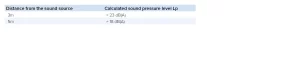
The sound pressure level therefore decreases rapidly as the distance increases: at a distance of three metres, the sound pressure level is approximately 23 dB(A), but only about 18 dB(A) at a distance of five metres. For this reason, a value reported from a distance of 5 metres may appear more attractive than a value measured or calculated from closer up, even though both describe the same aircraft. Where, on the other hand, the sound power level Lw is specified, the designer can calculate the sound pressure level for the exact distance and space that is relevant to their particular project.
4. Design recommendation
- Compare ventilation units based on their sound power level (Lw). The sound pressure level (Lp) reported at a specific distance is not, as such, suitable for comparing machines with one another, as it depends on the distance, the room acoustics and the measurement conditions.
- Ask for the power rating if the manufacturer only states the pressure rating. If only the sound pressure level measured at a specific distance (e.g. 3–5 m) is given, please also request the sound power level Lw so that you can calculate the sound pressure level at a distance suitable for your own location.
- Do not under-size the ventilation unit. An under-rated unit is forced to run at higher speeds, which increases both the noise from the airflow and structural vibration, and is more likely to result in complaints regarding noise levels.
- Use the standardised, A-weighted sound level. A power level measured in a reverberation chamber or using a similar standardised method, and reported as A-weighted, is more comparable than a field measurement taken at a single location.
Pitfalls:
- Measurement results in a domestic environment are strongly influenced by background noise, room acoustics and the measurement location; therefore, a single field measurement does not always provide a reliable picture of the machine itself.
- The regulations no longer specify a single, clear-cut decibel limit, so simply being ‘in compliance with the regulations’ does not in itself guarantee a good perceived noise level.
- People perceive sounds in different ways: even if the measured sound level is perfectly acceptable, individual frequencies may still cause discomfort to some users. For this reason, it is advisable to err on the side of caution when it comes to sound levels.
A good sound level is not just a matter of complying with regulations – it is an essential part of living comfort and high-quality ventilation.
5. References and related documents
MyVallox product documentation
product-specific noise level data (nämä saadaan esim. Vallox MySelecta -valintaohjelmasta).